
US tariff policy bulldozing Asia’s agriculture
28 January by GRAIN


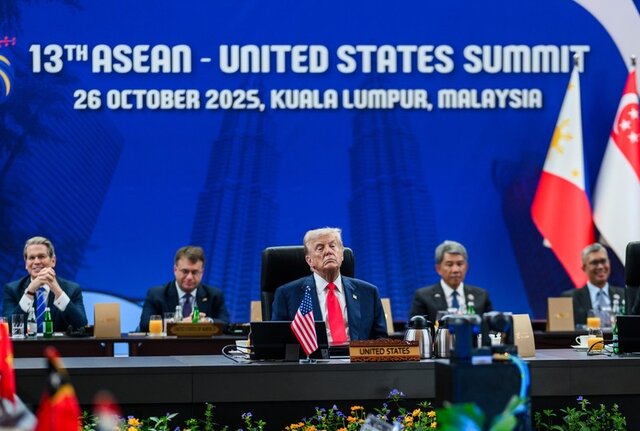
President Donald Trump attends the ASEAN Summit at the Kuala Lumpur Convention Center
Uploaded a work by The White House from https://www.flickr.com/photos/202101414@N05/54882714302/ with UploadWizard
On 8 December 2025, the Trump administration announced a US$12 billion Farmer Bridge Assistance package. This measure was meant to provide relief to US farmers. Paradoxically, the problems they’re currently facing are in part the result of the steep rise in tariffs the White House rolled out in April 2025, which imposed a 10% duty on all imports, including agricultural products, on top of country-specific “reciprocal tariffs”. Asian countries are particularly affected. Tariff rates ranged from 24% in Japan to almost 50% in Cambodia. [1]
The US defends these tariff increases by pointing to large and persistent annual trade deficits, which it claims are the result of a lack of reciprocity in bilateral trade, such as the effects of non-tariff barriers restricting US goods into foreign markets, as well as lower US import tariffs compared to those of its trading
Market activities
trading
Buying and selling of financial instruments such as shares, futures, derivatives, options, and warrants conducted in the hope of making a short-term profit.
partners.
This rise in tariffs has sharply boosted US customs revenue, which rose from US$7 billion in January to US$30 billion by September 2025. [2] However, this has done little to help US farmers. Instead, the policies have largely backfired: Trump’s tariff escalation triggered retaliatory measures from trade partners like China, leading to lost export markets - notably for US soybean farmers - falling commodity prices, higher costs for inputs such as machinery and fertilisers, and mounting debt within the US agricultural sector.
In November this year, the American Soybean Association (ASA) announced that 2025 would mark a third straight year of losses, while the National Corn Growers Association raised alarms last summer about “the economic crisis hitting rural America”. In 2025, losses for the nine major commodity crops ranged from US$35 billion to US$44 billion. [3]
Yet, Asian farmers are bearing the heaviest burden of Washington’s import tariffs. And tariffs are only part of the threat.
US agriculture trade deals in Asia
After last April’s “tariff wars” announcement, the Trump Administration rushed to finalise trade and investment deals in Asia, negotiating market access for its agricultural commodities Commodities The goods exchanged on the commodities market, traditionally raw materials such as metals and fuels, and cereals. with many governments in the region. Calling it “negotiating” is probably a stretch. Countries were forced to facilitate a 0% import duty on most US imports and allow Washington to bypass domestic standards and regulations. This authorised the US to unload its genetically modified (GM) foods and other products considered hasardous by other countries. In the likes of a typical neocolonial power, the US used tariff threats to achieve economic, political, and trade concessions.
Between July and October 2025, the US clinched trade deals (preliminary, upgraded or limited ones) with Vietnam, Indonesia, Japan, South Korea, Pakistan, Philippines, Thailand, Malaysia, Cambodia and China. The US is currently negotiating a trade deal with India, which faces a much harsher US duty fee of 50%.
In most of these trade negotiations, Asian economies were so terrified of US tariffs that they gave in like a house of cards. They accepted nearly every US demand in order to secure lower fees for their goods entering the US, giving away broad concessions and accepting harsh conditions. For the food and agriculture sector these demands included to [4]:
- Eliminate tariffs on 99% to 100% of the US products,
- Purchase of US agricultural products, including soybeans, soybeans meal, maize, wheat, rice, and cotton (over 90% of soya, maize, and cotton produced in the US is genetically engineered),
- Provide market access for US dairy products,
- Lower or drop various non-tariff barriers to ensure uninterrupted US exports,
- Align to US policies on supply chain security (to avoid sourcing from entities deemed high risk by the US government), dumping, trans-shipment (to avoid shipping goods through an intermediate country to disguise their true origin), and export control issues (to avoid transactions with sanctioned entities or prohibited end-users listed on various US watchlists),
- Recognise US regulatory oversight, and accept the US’s inspection system of meat, poultry, and dairy facilities as equivalent to its own standards, besides accepting certificates issued by the US regulatory authorities (side-lining domestic regulations as in the case of Halal certification in Malaysia),
- Eliminate pre-shipment inspection or verification requirements on imports of US goods,
- Harmonise domestic regulations to align with US regulations and standards (especially for granting fast approval to GM seeds and crops, GM food imports, and giving clearance to non-GM shipments containing any low-level presence occurrence of genetically modified organisms
Genetically Modified Organisms
GMO Living organisms (plant or animal) which have undergone genetic manipulation in order to modify their characteristics, usually to make them resistant to a herbicide or pesticide. In 2000, GMOs were planted over more than 40 million hectares, three quarters of that being soybeans and maize. The main countries involved in this production are the USA, Argentina and Canada. Genetically modified plants are usually produced intensively for cattle fodder for the rich countries. Their existence raises three problems.
- The health problem. Apart from the presence of new genes whose effects are not always known, resistance to a herbicide implies that the producer will be increasing use of the herbicide. GMO products (especially American soybeans) end up gorged with herbicide whose effects on human health are unknown. Furthermore, to incorporate a new gene, it is associated with an antibiotic-resistant gene. Healthy cells are heavily exposed to the herbicide and the whole is cultivated in a solution with this antibiotic so that only the modified cells are conserved.
- The legal problem. GMOs are only being developed on the initiative of big agro-business transnationals like Monsanto, who are after the royalties on related patents. They thrust aggressively forward, forcing their way through legislation that is inadequate to deal with these new issues. Farmers then become dependent on these firms. States protect themselves as best they can, but often go along with the firms, and are completely at a loss when seed thought not to have been tampered with is found to contain GMOs. Thus, genetically modified rape seed was destroyed in the north of France in May 2000 (Advanta Seeds). Genetically modified maize on 2600 ha in the southern French department of Lot et Garonne was not destroyed in June 2000 (Golden Harvest). Taco Bell corn biscuits were withdrawn from distribution in the USA in October 2000 (Aventis). Furthermore, when the European Parliament voted on the recommendation of 12/4/2000, an amendment outlining the producers’ responsibilities was rejected.
- The food problem. GMOs are not needed in the North where there is already a problem of over-production and where a more wholesome, environmentally friendly agriculture needs to be promoted. They are also useless to the South, which cannot afford such expensive seed and the pesticides that go with it, and where it could completely disrupt traditional production. It is clear, as is borne out by the FAO, that hunger in the world is not due to insufficient production.
For more information see Grain’s website : https://www.grain.org/.
- The health problem. Apart from the presence of new genes whose effects are not always known, resistance to a herbicide implies that the producer will be increasing use of the herbicide. GMO products (especially American soybeans) end up gorged with herbicide whose effects on human health are unknown. Furthermore, to incorporate a new gene, it is associated with an antibiotic-resistant gene. Healthy cells are heavily exposed to the herbicide and the whole is cultivated in a solution with this antibiotic so that only the modified cells are conserved.
- Take steps to resolve long-standing intellectual property issues, e.g., acceding to the International Convention for the Protection of New Varieties of Plants (UPOV) 1991 (as accepted by Malaysia and Cambodia).
In return for accepting the above, the US committed to keeping its current 19% to 20% reciprocal tariff rate on imports, with some exceptions (such as semiconductors) that would be eligible for a 0% reciprocal tariff rate. [5]
Impact of trade deals on food and agriculture
Through its tariff policy, the US succeeded in imposing one-sided commitments on standards and technical processes, forcing countries to automatically acknowledge US food and agricultural control systems and all certificates issued by US regulatory authorities. Disturbingly, all these engagements are made without obliging the US to make any reciprocal pledge to Asian countries to facilitate the access of their agricultural and dairy products into US markets.
Japan, which rarely compromised on rice imports, was forced to increase its imports of US rice by 75%, on top of a major expansion of import quotas and the purchase of US$8 billion worth of US goods, including maize, soybeans, fertiliser, bioethanol, and aviation agrofuel. In the case of Bangladesh, even though it does not have any trade deal with the Washington, in order to secure lower import tariffs in the US, Bangladesh agreed to purchase 700,000 metric tons of wheat annually over the next 5 years and US$1 billion worth of soybean in the coming twelve months. [6] [7] Some countries, like Thailand, Malaysia, and Cambodia even accepted US demands to refrain from signing trade deals with a country that can jeopardise essential US interests.
China was the only Asian government that retaliated against the US’ tariff policy. Despite an increase in its reciprocal tariff to 145%, it struck back by imposing a 125% tariff on US products entering China and halting its purchase orders of US soya and maize, procuring it instead from Latin America. In November 2025, both countries eventually reached a trade “framework” agreement. China committed to purchase at least 12 million metric tons of US soybeans in November-December 2025 and at least 25 million metric tons in 2026, 2027, and 2028, respectively. [8]
Defying US trade coercion
Some countries are now regretting having accepted one-sided US conditions. Indonesia is one. It is now pushing back against the coercive clauses of the trade deal, arguing that they impinge on its political and economic sovereignty by restricting deals with US rivals like China. Facing a US demand for a US$350 billion investment, South Korea successfully negotiated a reduced commitment. It will now invest US$200 billion directly over ten years, with a further US$150 billion dedicated to shipbuilding. Japan finds itself in a similar renegotiation. Its initial US$550 billion investment pledge in the US would have allowed the US to keep 90% of the profits, but Japan now wants the profits shared according to the scale of each nation’s contribution. [9]
In Malaysia, the US trade deal has sparked significant controversy, with critics arguing it undermines national sovereignty and the country’s long-standing neutrality on foreign policy. Groups like Sahabat Alam Malaysia, and the Consumers’ Association of Penang, have condemned the agreement as a “surrender of Malaysia’s sovereignty”. They accuse the government of failing to explain the deal’s implications, warning it would grant US companies tax exemptions, reduce regulations for US investors, give US regulators veto power over Malaysian standards, and allow US interests to shape Malaysian foreign policy. [10]
The US is now in the final stages of negotiating a trade deal with India. It’s becoming clear that even with an agreement, India may not be spared from harsh US tariffs or non-tariff conditions. South Korea serves as a clear example: despite having a free trade agreement with the US that grants near-zero tariffs on US goods, it was still hit with a 25% import tariff. Given this trend across the region, it is likely the US will push for one-sided obligations and severe conditions in the Indo-US deal, particularly in sensitive sectors such as agriculture, dairy, and fisheries- areas critical to India’s food security and the livelihoods of millions of small-scale producers. While India currently maintains strict biosafety controls-prohibiting GM products and permitting only one GM crop (Bt cotton)-the proposed trade deal could severely threaten these regulations. Based on precedents in other Asian countries, the agreement is expected to pressure India to harmonise its food safety and biosafety standards with those of the United States.
The Indian Forum for Trade Justice has cautioned the government about signing such an unfair trade deal with the US, stating that in the current negotiations, “India’s interests will not be safeguarded by being subservient...Instead, they will be served by being resolute and firm and keeping our long-term economic prospects, developmental goals, and ecological security in mind”. [11]
Source : GRAIN
Footnotes
[1] Cambodia (49%), Laos (48%), Vietnam (46%), Myanmar and Sri Lanka (44%), Bangladesh (37%), Thailand (36%), China (34%), Indonesia and Taiwan (32%), Pakistan (29%), India (26%), South Korea (25%), Brunei, Japan and Malaysia (24%). From: “Regulating Imports with a Reciprocal Tariff to Rectify Trade Practices that Contribute to Large and Persistent Annual United States Goods Trade Deficits”, Executive Orders, The White House, 2 April 2025 (See Annex 1), https://www.whitehouse.gov/presidential-actions/2025/04/regulating-imports-with-a-reciprocal-tariff-to-rectify-trade-practices-that-contribute-to-large-and-persistent-annual-united-states-goods-trade-deficits/
[2] “Tariff Revenue Soars in FY 2025 Amid Legal Uncertainty”, Committee for a Responsible Federal Budget, Washington DC, 27 October 2025, https://www.crfb.org/blogs/tariff-revenue-soars-fy-2025-amid-legal-uncertainty
[3] 3 Jason Ma, “More financially distressed farmers are expected to lose their property soon as loan repayments and incomes continue to falter”, Fortune, 13 December 2025,https://fortune.com/2025/12/13/farm-economy-agriculture-financial-distress-farmers-forced-sales-liquidation-loan-repayments-soybean-incomes/
[4] Various Fact Sheets issued by the White House on its trade deals with Asian countries – https://www.whitehouse.gov/fact-sheets
[5] “Clarification of Exceptions Under Executive Order 14257 of April 2, 2025, as Amended”, The White House, 11 April 2025, https://www.whitehouse.gov/presidential-actions/2025/04/clarification-of-exceptions-under-executive-order-14257-of-april-2-2025-as-amended/
[6] “Bangladesh approves US wheat imports, hoping to ease trade tensions”, Reuters, 7 October 2025, https://www.reuters.com/world/asia-pacific/bangladesh-approves-us-wheat-imports-hoping-ease-trade-tensions-2025-10-07/
[7] “$1 Billion Soybean Agreement Strengthens U.S.-Bangladesh Agricultural Trade”, US Embassy Dhaka, 4 November 2025, https://bd.usembassy.gov/1-billion-soybean-agreement-strengthens-u-s-bangladesh-agricultural-trade/
[8] “Fact Sheet: President Donald J. Trump Strikes Deal on Economic and Trade Relations with China”, The White House, 1 November 2025, https://www.whitehouse.gov/fact-sheets/2025/11/fact-sheet-president-donald-j-trump-strikes-deal-on-economic-and-trade-relations-with-china/
[9] Lim Hui Jie, “U.S.-Indonesia trade deal is in danger of falling apart”, CNBC, 10 December 2025, https://www.cnbc.com/2025/12/10/us-indonesia-trade-deal-in-jeopardy-.html
[10] “Malaysia-US pact surrenders Malaysia’s sovereignty”, 30 October 2025, https://foe-malaysia.org/articles/malaysia-us-pact-surrenders-malaysias-sovereignty/
[11] “Open letter on why India must not give in to US tariff blackmail”, Forum for Trade Justice - 30 August 2025, https://www.bilaterals.org/?open-letter-on-why-india-must-not
Other articles in English by GRAIN (26)
-
The Avocados of Wrath
8 May 2023, by GRAIN
Sign on statement
Roundtable on Sustainable Palm Oil (RSPO): 19 years is enough2 December 2022, by CADTM , Collective , GRAIN , Friends of the Earth
-
Unmasking the China-Pakistan Economic Corridor
16 May 2021, by GRAIN
-
Barbarians at the barn: private equity sinks its teeth into agriculture
17 December 2020, by GRAIN
-
What do FTAs mean for African women? A critical look into the African Continental Free Trade Area
15 December 2020, by GRAIN
-
Development banks must be held accountable for their disastrous oil palm plantation investments in the Congo
25 September 2020, by GRAIN
-
Agro-imperialism in the time of Covid-19
16 July 2020, by GRAIN
-
Millions forced to choose between hunger or Covid-19
26 May 2020, by GRAIN
-
The Daewoo-Madagascar land grab: Ten years on
19 November 2018, by GRAIN , TANY
-
Colonialism’s new clothes: The EU’s Economic Partnership Agreements with Africa
22 August 2017, by GRAIN
-
The port of Chancay: a dramatic boost for extractivism in South America
11 February - GRAIN -
Gulf investors in, locals out: Pakistan’s corporate farming agenda
9 June 2025 - GRAIN, Pakistan Kissan Rabita Committee -
Debt cancellations and peasant mobilizations in Europe from Antiquity to the 20th Century
12 May 2025 - Eric Toussaint -
Can pension systems be part of the fight for food sovereignty?
2 May 2025 - GRAIN -
Voices of Pastoralist Women: Leadership and Resilience in the Month of Working Women’s Struggle
25 April 2025 - Collective
-
A renewed call to action: to resist, to imagine, and to build a world where no one is entangled to debt, forced to migrate, and die to survive
11 June 2025 - Liz Ferrer , Eula Dela Sierra (Sumpai Mindanao) -
Debt and Immigration : 13 th Asian Regional School, Quezon City, Philippines
3 June 2025 - Fernanda Gadea -
South Asia: ‘It’s crucial to fight the far right in Pakistan and the region’
17 September 2024 - Farooq Tariq , Israel Dutra -
Report on Asia at the CADTM World Assembly, Dakar, 13 -16 November 2021
27 January 2022 - CADTM Asie -
[Video] Illegitimate debt and debt audits | Overview of debt in Asia
3 June 2021 - Eric Toussaint, Iolanda Fresnillo, Eurodad, Daniel Jeong-Dae Lee, Kjetil Abildsnes
-
The World After American Decline
21 October 2025 - Michael Roberts, Arman Spéth -
India after the Tianjin summit and in the midst of the climate crisis – an overview
29 September 2025 - Sushovan Dhar -
Tariffs and the US economy
5 August 2025 - Michael Roberts
CADTM
COMMITTEE FOR THE ABOLITION OF ILLEGITIMATE DEBT
8 rue Jonfosse
4000 - Liège- Belgique
+324 56 62 56 35
info@cadtm.org
